
The Critical Role of Simulations and Integrated Modeling in Nuclear Fusion Research
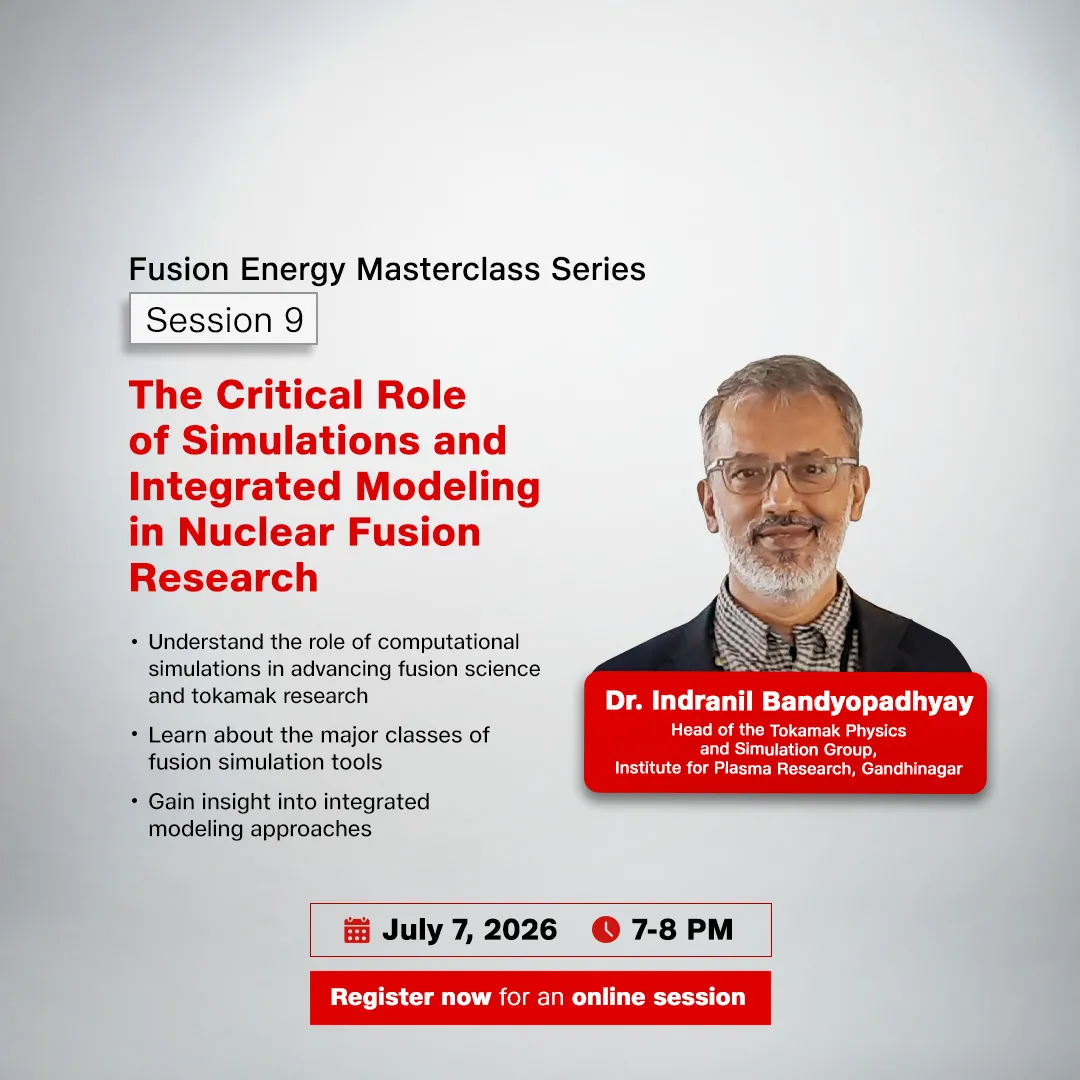
Speakers

Session Description
This session will provide an overview of the computational tools that have become essential to modern fusion research. The talk will introduce the major classes of simulation codes used to study plasma equilibrium, stability, turbulence, transport, heating, current drive, disruptions, and runaway electrons in tokamaks. It will also discuss the growing role of integrated modeling, where multiple physics processes are combined to improve predictive capability for fusion experiments and future reactor design. The session will highlight both the capabilities and current limitations of these modeling approaches, offering participants a practical perspective on how simulations support fusion research and development.
Key Highlights
- Understand the role of computational simulations in advancing fusion science and tokamak research.
- Learn about the major classes of fusion simulation tools, including equilibrium, stability, turbulence, transport, heating, and disruption modeling codes.
- Gain insight into integrated modeling approaches that combine multiple plasma physics processes within a unified framework.
- Appreciate the strengths, limitations, and current status of simulation-driven predictions for future fusion devices and reactors.
Who Should Attend
This Masterclass will benefit students, researchers, and faculty from diverse fields including physics, materials science, electrical and mechanical engineering, and energy systems. It will also interest professionals from renewable energy, advanced materials, and technology sectors who wish to understand how fusion research could shape future energy solutions. Policymakers, R&D leaders, and industry stakeholders engaged in science and technology strategy will find valuable insights on aligning academic innovation, industrial development, and policy direction toward India’s and the world’s fusion mission.