
Tech Trek 3.0: Young Innovators on an AI Immersion Journey
"The amount of data that exists from the dawn of civilisation till the year 2000 was about five exabytes. That is the amount of data we create every other day in the world today."
-Mr. Siddharth Sureka, Chief AI Officer, Motilal Oswal Financial Services Limited
Twenty-five centuries of human knowledge. Recreated every 48 hours. That was the number Mr. Sureka opened with, and it set the tone for the twelve days that followed: days built around the scale, speed and stakes of the AI moment this cohort is stepping into.
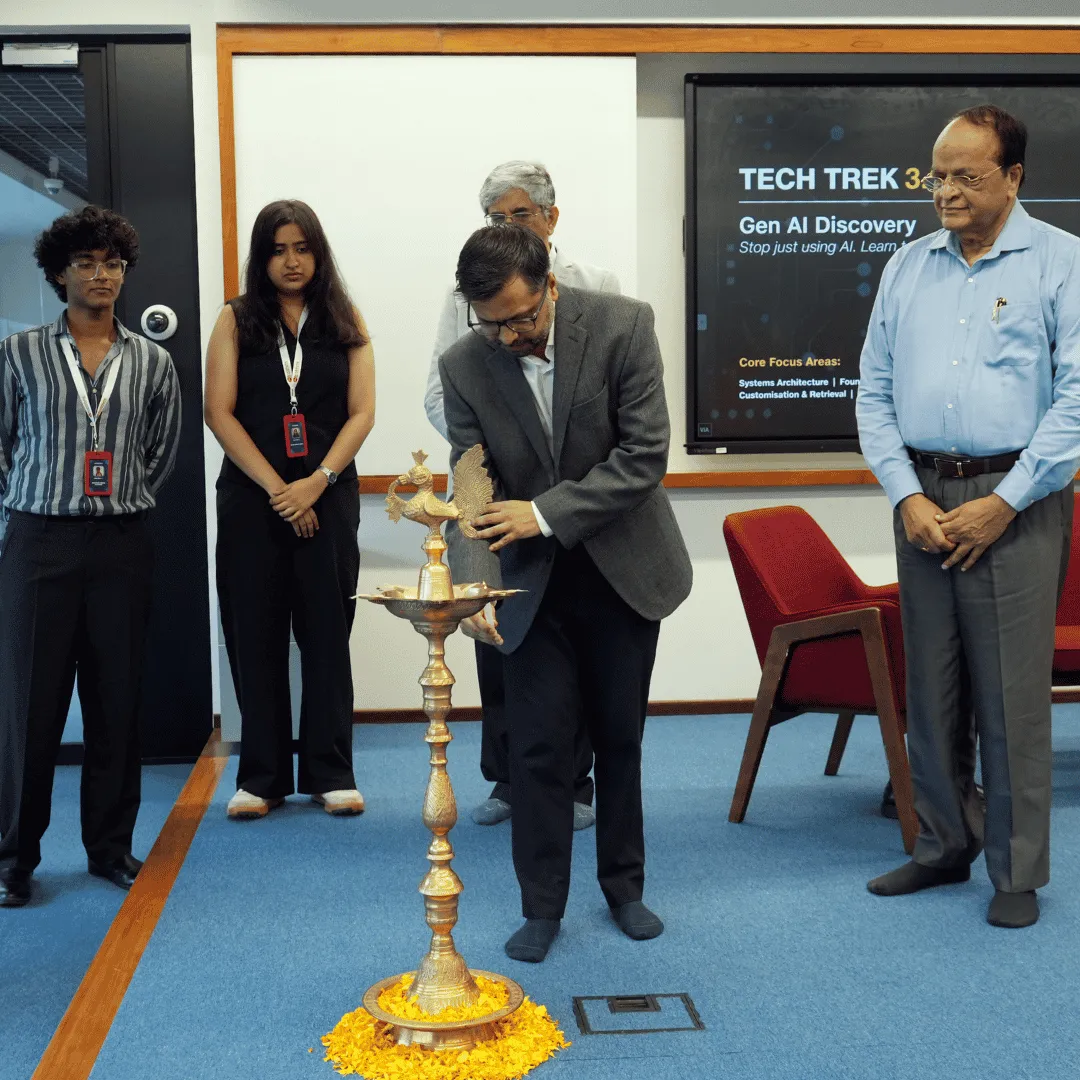
The moment set the stage for Tech Trek 3.0, Jio Institute's 12-day summer immersion programme in Artificial Intelligence, which opened with an inaugural ceremony at the institute's campus.
The ceremony was graced by Chief Guest Mr. Siddharth Sureka, Chief AI Officer at Motilal Oswal Financial Services Limited; Strategic Advisor Dr. Rajasekharan Pillai; and Dean Dr. Shailesh Kumar. The morning opened with the traditional lighting of the lamp, followed by a series of addresses that set the tone for the twelve days ahead.
Collecting Pebbles: Dr. Shailesh Kumar's Welcome Address
Dr. Shailesh Kumar led with a story. A girl asks an old woman in the forest for the meaning of life. The old woman tells her to carry home a few pebbles and sleep on them. By morning, they have turned to gold, and the girl feels a strange pang of regret: if only she had known, she would have picked up more.
The moral, he told the room, is simple. The next twelve days are about collecting as many pebbles as possible: skills and experiences whose value may only become clear years later. His own, he said, was a typing class he was forced into after school, one that felt pointless until it became essential during his doctoral years of nonstop writing.
From there, he distilled the purpose of education into two ideas that matter more than grades or job offers. First: rediscover yourself, through the struggle and iteration of doing things you have never done before. Second: reimagine the world through technology.
AI, Access and Nation-Building: Mr. Siddharth Sureka's Keynote
Two decades ago, training a single neural network to recognise a handwritten digit took Mr. Sureka's team weeks. Today, the same job takes minutes. That leap, he told the students, is the scale of opportunity standing in front of them.
He tied AI to India's Viksit Bharat vision, highlighting its role in expanding access to finance, healthcare and knowledge, while showcasing uses from multilingual investing and fraud detection to farming and rural healthcare.
He outlined the AI syllabus—system architecture, foundation models, applied engineering, retrieval systems and autonomous agents—before closing with a message to students: stop worrying about jobs and start building. “I think you'll be able to create jobs,” he said.
From STEM to STEAM: Dr. Rajasekharan Pillai's Reflections
Dr. Pillai opened with a real-world proof point: a recent conversation with Dr. D. Nageshwar Reddy of AIG Hospitals, Hyderabad, an institution that has grown from a small clinic twenty-five years ago into a major AI-enabled healthcare centre now employing over a hundred computer scientists. Sustained, technology-led institution-building, he said, looks exactly like this.
Turning to the cohort, Dr. Pillai described STEM as part of a broader shift toward STEAM, where the arts and humanities provide the context that gives science and engineering meaning. He concluded by reminding students that artificial intelligence only exists in relation to human intelligence, and that embracing AI should never come at the expense of our own.
A Cohort from Across India
Tech Trek has grown with each edition. Its first two editions trained over 60 students, postgraduates and young professionals across STEM fields. This third edition goes further, moving into hands-on AI deployment and building on the foundations laid by earlier cohorts.
This edition brought together 29 students from 9 states, including Maharashtra, Telangana, Andhra Pradesh, Gujarat, Punjab, Uttar Pradesh, Karnataka, Tamil Nadu and New Delhi. They came from institutions such as IIT, IIM, Mahindra University, Thapar Institute, KJ Somaiya, SRM Institute, Manipal University, Atlas SkillTech University, and several colleges in Mumbai and Navi Mumbai, with a near-even mix of male and female participants.
The formal part of the morning then gave way to something lighter, as each student introduced themselves. First-year engineers sat next to postgraduates preparing for research careers, a quick glimpse of how wide this cohort's map really is. The dignitaries felicitated Mr. Sureka, and everyone gathered for a group photo to mark day one.
With classroom sessions, industry visits and hands-on projects still to come, Tech Trek 3.0 has already taught its first lesson: collect your pebbles now, because you won't know which ones turn to gold later.