
The Digital Athlete: How Data and AI are Rewriting the Rules of Indian Sports Management
“If a coach cannot understand your data dashboard in five seconds, that data is useless.” In a world obsessed with complex algorithms and AI, this grounding statement became the defining moment of the technology session. It highlighted the critical gap between high-end code and on-ground execution, challenging the room to move beyond "datafication" to true, actionable intelligence that keeps athletes injury-free and podium-ready.
The Jio Institute campus witnessed a gathering of the finest minds in Indian sports governance and administration for the second Indian Sport Management Conference (ISMC 2025). With over 200 participants, the event served as a crucible for ideas centred on the theme “Olympic Vision 2036.”
The day-long conclave featured a stellar lineup of speakers who set the context for India’s ambitious bid, including Ms. Vita Dani, Co-Owner, Chennaiyin FC; Chairperson, Ultimate Table Tennis and Promoter, Dani Sports Foundation; Col. N.S. Johal, CEO, TOPS; Shri Narendra Modi, GM, Gujarat Sports Infrastructure Development; Dr. Kamila Swart-Arries, Hamad Bin Khalifa University, Qatar and many more.
From Intuition to Intelligence
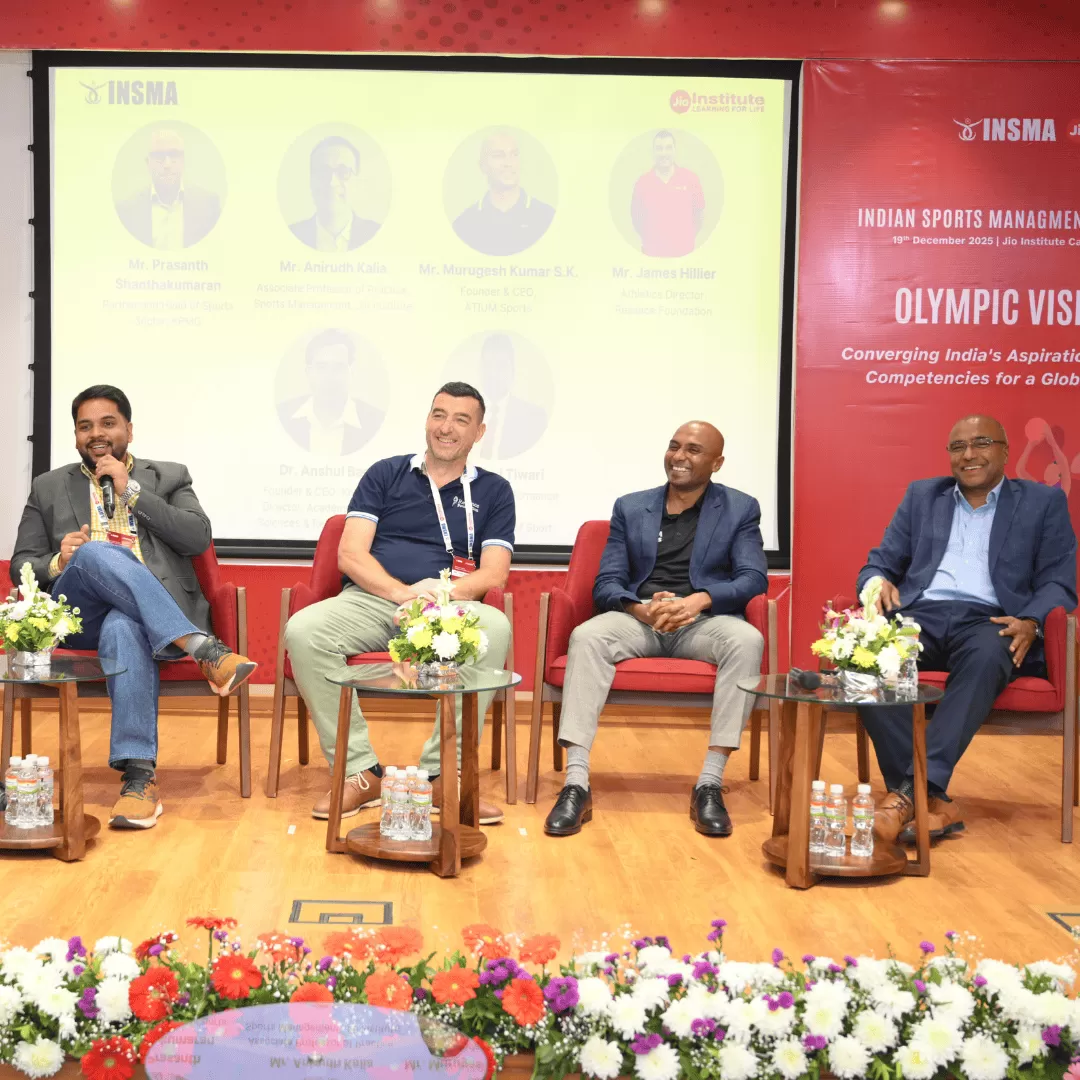
Following a futuristic special address by Dr. Shailesh Kumar, Dean, Jio Institute on the "Sports Operating System," the focus shifted to the practicalities of implementation in the second panel discussion: "Data, Tech & the Future of Sports Management in India."
Chaired by Mr. Prasanth S, Head, Sports Advisory, KPMG and moderated by Mr. Anirudh Kalia, Associate Professor of Practice in Sports Management, Jio Institute, the panel featured diverse sports management and digitisation practitioners: Mr. Murugesh Kumar S.K, Founder & CEO, ATIUM Sports; Mr. James Hillier, Athletics Director, Reliance Foundation; Dr. Anshul Bagai, Founder & CEO, Khelo Tech and Dr. Rahul Tiwari, Head of Sports Performance Analysis, Inspire Institute of Sport.
The Datafication Challenge
The discussion opened with the fundamental challenge of "datafication" at the grassroots level. Mr. Murugesh Kumar highlighted that while elite athletes are well-tracked, the system to feed tis data remains manual to a large extent.
“You cannot have AI without good data. Currently, less than 10% of grassroots academies track meaningful data. We are facing a 'garbage in, garbage out' scenario. We need standardised, simple data collection tools that a district coach can use on a smartphone,” Mr. Murugesh argued.
Bridging the Coach-Tech Divide
Dr. Anshul Bagai addressed the friction that often exists between traditional coaching methods and modern analytics. He emphasised that technology must be an enabler, not an intimidator.
“If a coach cannot understand the dashboard in five seconds, the data is useless. Our job as technologists is to translate complex biomechanics into simple, actionable insights. We need to empower the coach, not replace them,” Dr. Bagai stated.
Performance and Injury Prevention
Mr. James Hillier brought the perspective of high-performance training. He noted that the highest Return on Investment (ROI) for technology currently lies in injury prevention rather than just performance enhancement.
“At Reliance Foundation, we use data to manage load. It’s about keeping the best athletes on the field. We are moving from reactive medicine to predictive bio-mechanics. If we can predict an injury before it happens, that is the difference between gold and silver,” Mr. Hillier explained.
The Future: Computer Vision
Dr. Rahul Tiwari spoke about the next frontier: moving away from wearable sensors to non-invasive tracking.
“The future is computer vision. We are moving towards a world where cameras automatically track player movements, velocity, and fatigue without the need for wearable sensors. This democratization of tech will allow us to scout talent from the remotest parts of India without expensive equipment,” Dr. Tiwari predicted.
Mr. Prasanth S wrapped up the session by linking these technological advances to the business side of sports.
“Data isn't just for the athlete; it is revolutionising the fan experience. As we approach 2036, the 'Digital Twin' of the athlete will become a valuable asset, raising important questions about data privacy and ownership that managers must be ready to handle,” he concluded.
Conclusion
The session underscored that technology is the accelerator that will propel India towards its 2036 goals. The consensus was clear: India has the engineering talent and the sporting raw material; the challenge lies in integrating the two. As the conference concluded with the Valedictory ceremony, the message was evident—the next generation of Indian sports managers must be as fluent in data analytics as they are in sports administration.