
When AI Can Act, Where Should Humans Still Lead?
For years, the question businesses asked about artificial intelligence was simple: What can AI do for us?
At Convergence 2026, the question had changed.
As AI moves beyond generating content and insights to reasoning, planning and executing entire business workflows, a more fundamental question is emerging: when machines can act, which decisions should remain with people—and who is accountable when an autonomous system gets it wrong?
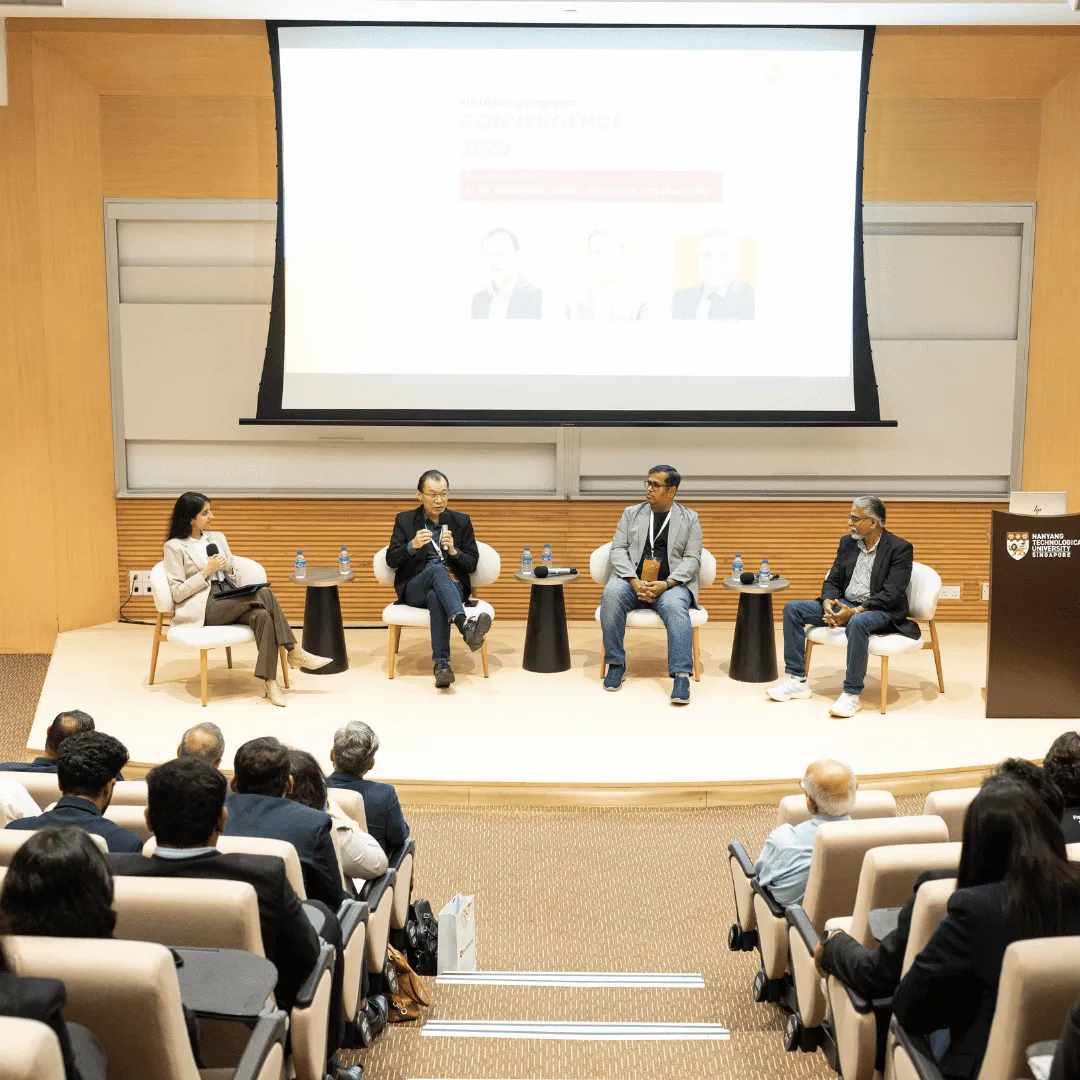
This question shaped the fourth edition of Jio Institute’s flagship international conference, held at the Nanyang Executive Centre, NTU Singapore. Bringing together leaders from technology, banking, academia and business, the conference explored “Transforming Business Through Autonomous Intelligence” through three keynotes and two panel discussions.
Around 400 participants followed the proceedings live from India, alongside delegates and professionals from across the region.
When Intelligence Becomes Abundant
The evening opened with a challenge to a familiar assumption: if AI can increasingly analyse, plan and execute, what remains for humans to decide?
Mr Madhur Mayank Sharma, Vice President, AI Product Engineering & Global Head of AI Services & Accelerator, SAP, argued that as intelligence becomes increasingly abundant and inexpensive, human judgement becomes the scarce resource.
Drawing on examples of AI systems producing confident but incorrect recommendations, he highlighted a critical leadership responsibility: knowing when to trust an AI agent, when to question it and when to stop it.
A pricing agent that operated flawlessly for ten days but eventually caused a loss of approximately $23 million reinforced the point. The goal, he argued, is not maximum autonomy, but appropriate autonomy—with human intervention designed around the consequences of failure.
The New Bottleneck: Verification
If AI can produce an answer in seconds, what happens when every answer needs to be checked?
Mr Anand S, LLM Psychologist, Straive, Singapore, explored the emerging phenomenon of “AI fatigue”, where the speed of generation creates a new bottleneck: verification.
His approach was practical. Define the test before asking AI to perform the task. Use multiple models to triangulate outputs. For verifiable work, ask AI to test its own answers.
His experiments showed how dramatically this could reduce errors: requiring agreement between two models reduced errors from 14% to 3.7%, while five-model agreement brought them down to 0.7%.
The larger lesson was about management, not technology: verification is becoming an essential AI skill.
From Technology Adoption to Organisational Transformation
The conversation then then widened from individual users to the region.
Ms Anni Tankhiwale, Director, Agency & Enterprise Partnerships, Meta, Singapore, examined the rapid adoption of AI across Asia-Pacific and argued that responsible adoption must be treated as an organisational commitment, not simply a technology purchase.
With AI increasingly becoming embedded in everyday work, the challenge is no longer only access to powerful models. It is ensuring that people have the skills to use them meaningfully.
Her message to leaders was direct: invest in people, not just in tools.
What Happens When AI Enters the Enterprise?
The two panel discussions brought these ideas into the realities of business.
The first, AI for Enterprise Growth, Innovation and Marketing, explored how AI is changing customer expectations, organisational models and the nature of work.
Mr Oliver Tan, Mr C. K. Vishwakarma and Mr Bala Murali Raghavan, moderated by Ms Gauri Bhatia (PGP Management (Marketing)) returned repeatedly to the same foundation: start with the business problem, prepare the people and mindset, then bring in the technology.
As Mr Vishwakarma put it: “It’s not AI first. It’s transformation first.”
The second panel, AI-Driven Future of Finance, examined what happens when an industry built around certainty adopts technology that is probabilistic by design.
Mr Alvin Eng, Dr James Ong, Mr Ahmed Muzammil and Mr Suresh V. Shankar, moderated by Mr Vishwas Mordani, explored trusted AI, governance, risk, regulation and the changing role of humans in financial decision-making.
One principle emerged clearly: the greater the consequence of a decision, the more deliberately autonomy must be designed.
From Knowledge to Wisdom
The evening closed with Dr Dipak Jain, Vice Chancellor, Jio Institute, who reflected on how each technological wave has changed what learners can do.
Computers brought speed. The internet brought search. AI now brings structure.
But structure is not the same as wisdom.
For Dr Jain, management education remains fundamentally about structured thinking, critical reasoning and human intellect. His closing message distilled the conference into two words: responsibility and accountability.
“Competencies can be outsourced,” he said, “but responsibility and accountability cannot be outsourced.”
One Evening. One Larger Question.
Across keynotes and panels, Convergence 2026 approached autonomous intelligence from different perspectives—technology, marketing, enterprise, finance, learning and regional adoption.
Yet the conversation kept returning to the same idea.
AI may increasingly take on the execution. It may reason, recommend, automate and act.
But people must still decide where it should act, when its output should be questioned and who remains accountable for the outcome.
That is the leadership challenge of autonomous intelligence.
Technical proficiency may be the engine. Managerial strategy may be the steering wheel. But as Convergence 2026 demonstrated, human judgement is what ultimately does the steering.