
Beyond the Bit: Charting India’s Leap into the Quantum Future
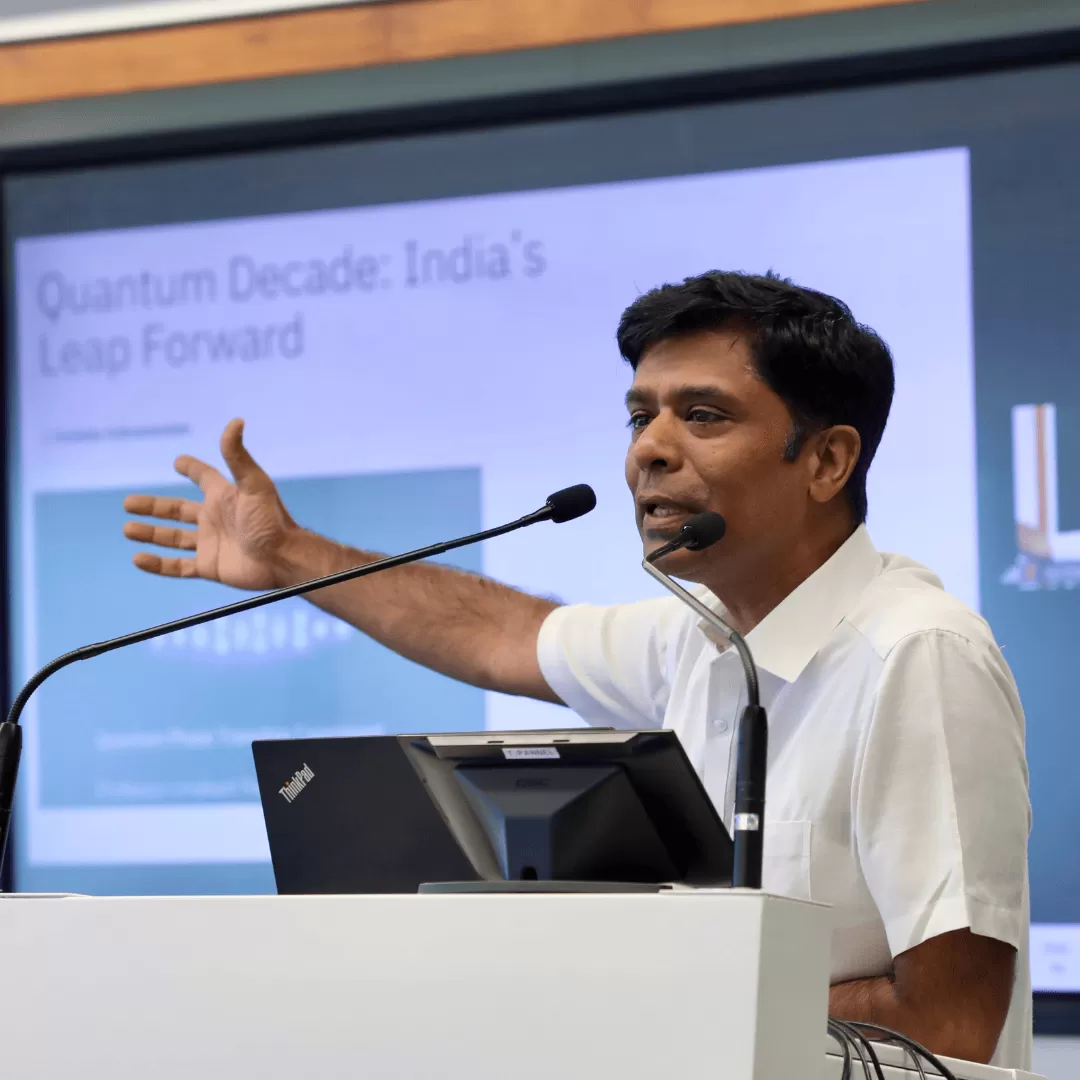
The inaugural session of the Jio Institute Author Talk Series set an extraordinary standard, hosting Dr. L. Venkata Subramaniam for a visionary exploration of his book and quantum computing, Quantum Nation: India’s Leap Into the Future. The talk provided a comprehensive landscape of where quantum computing stands and why its arrival is not just inevitable, but necessary for solving humanity's most complex challenges.
The Great Divide: Why Classical Computing Has Failed
Dr. Subramaniam's address centred on a compelling idea: classical computing, despite its spectacular achievements built on Moore's Law, has hit fundamental barriers. He argued that the future requires an entirely new computational paradigm, citing three key problems that current supercomputers cannot or will not solve:
The Challenge of Simulating Nature
The most significant limitation of classical computing is its inability to simulate nature. To grasp this massive capability gap, Dr. Subramaniam offered a powerful anecdote:
“To accurately simulate a single caffeine molecule for one fraction of a second, a classical computer would require 1048—that’s one-tenth the number of atoms present on Earth. Are we going to ever build a supercomputer that big? I don't think so. It's never going to happen.”
Quantum, with just 160 qubits, bypasses this limitation entirely. This capability is critical for accelerating drug discovery, where medicine is designed to block proteins that have lost their shape (the root of diseases like cancer). Today, this is done through slow, expensive "wet lab" experiments. The same principle applies to developing replacement plastics, lighter materials for ISRO space missions, and new electric vehicle battery materials.
The Mathematical Hurdle: Breaking Encryption
The second problem is one of time: prime factorisation, the basis of modern encryption (passwords and banking transactions).
“The best supercomputer will take 8 billion years to factorise a 2,048-bit integer.”
By contrast, the Shor’s algorithm, proven in 1994, shows a quantum computer could, theoretically, complete this in just six hours, demonstrating an exponential speed up.
The AI Energy Crisis
The third limitation concerns the staggering energy consumption of modern Artificial Intelligence: “Every time you build one LLM, what do you build on the other side? A power station.”
He cited the US President Donald Trump, on his very first day in office, declaring an energy emergency. Quantum systems show theoretical evidence of requiring far fewer examples, pointing toward an energy-sustainable future.
New Branch of Computing
Quantum computing is fundamentally different, relying on three special properties that traditional processors cannot exploit.
- Superposition: A classical bit is only zero or one; a qubit can be both zero and one simultaneously.
- Entanglement: Multiple qubits can be connected and simultaneously share information, a feature famously described by Einstein as “spooky action at a distance”.
Hence Dr. Subramaniam stated: “Quantum computing is not just a faster or better version of classical systems. It is an entirely new branch of computing.”
He confirmed that quantum computers will not replace classical systems, but the future lies in coexistence, with CPUs, GPUs, and QPUs (Quantum Processing Units) working together.
India’s Strategic Quantum Leap
The next critical phase is achieving "quantum advantage"—creating a useful, transformative application that makes the technology accessible outside the lab. Dr. Subramaniam passionately argued that this use case must come out of India.
- The Talent Edge: He stressed that the maximum talent for quantum computing sits in India. He highlighted that Indians are the largest users of quantum computers globally. To exemplify his point, Dr. Venkata shared that a large number of high-school students registered for an NPTEL quantum course, demonstrating an “unheard of” groundswell of interest.
- The NQM Blueprint: To harness this talent, the government launched the National Quantum Mission (NQM), distributing approximately ₹6,000 crores to 43 institutions and funding startups with up to ₹25 crores. He framed this initiative as the country’s chance to prevent a recurrence of past technological misses, noting that “We need quantum advantage to come out of India from the Indian companies.”
Dialogue and Development: Key Discussions
The event concluded with an insightful Q&A session and a fireside chat with Dr. Samik Mukherjee, Assistant Professor and Principal Investigator, SMEIT Lab, Jio Institute.
Q&A Highlights: The Culture of Debate
The audience Q&A explored diverse topics, including the need for a culture of debate in academia. Dr. Subramaniam agreed, noting that the power of quantum mechanics was born from the back-and-forth dialogue between giants like Einstein and Bohr.
Other topics included:
- Finance: Algorithmic trading using quantum systems (citing the HSBC example where quantum/classical models achieved a 34% prediction improvement).
- Optimisation: Vehicle routing and scheduling, and the distinction between annealing-based and universal quantum computers.
- Materials: The race for the optimal material for scalable qubits, where the clear winner (between superconducting, light, and spin qubits) has yet to emerge.
Fireside Chat: The Way Forward
The fireside chat tackled the practicalities of the NQM. Dr. Subramaniam was candid about the challenges, noting that the country needs new central infrastructure (like test facilities) that currently do not exist.
Addressing the role of emerging institutes like Jio Institute, he advised them to “jump forward, leap forward” and invest in "big thinking". He championed the model of IIT Madras’s Research Park and its successful online data science courses as blueprints for creating industry enablement and brand awareness. He concluded with a strong message for students: given the global shortage of quantum personnel, acquiring skills in mathematics and programming presents a golden opportunity for the next generation.
Key Takeaways and Conclusion
The session affirmed that India is uniquely positioned to lead the next technological revolution.
- Quantum is Transformative: Quantum computing is a new branch of computing required to solve problems intractable for classical systems, from simulating new medicines to ensuring energy-efficient AI.
- Talent is Paramount: India has the largest pool of quantum talent globally, making it the most likely source of the revolutionary quantum "use case".
- The NQM is the Enabler: The government's ₹6,000 crore investment provides the intent and resources needed to create necessary infrastructure and industrial engagement. For ground-breaking ideas, there is much more where that came from!
- Coexistence is the Future: Quantum computers will not replace classical computers; rather, the future relies on the synergistic coexistence of CPUs, GPUs, and QPUs.
Dr. Subramaniam’s talk was a rallying call, confirming that by combining strategic government intent, academic curiosity, and industry ambition, India can secure its seat at the global table and successfully launch itself into the age of the Quantum Nation.