
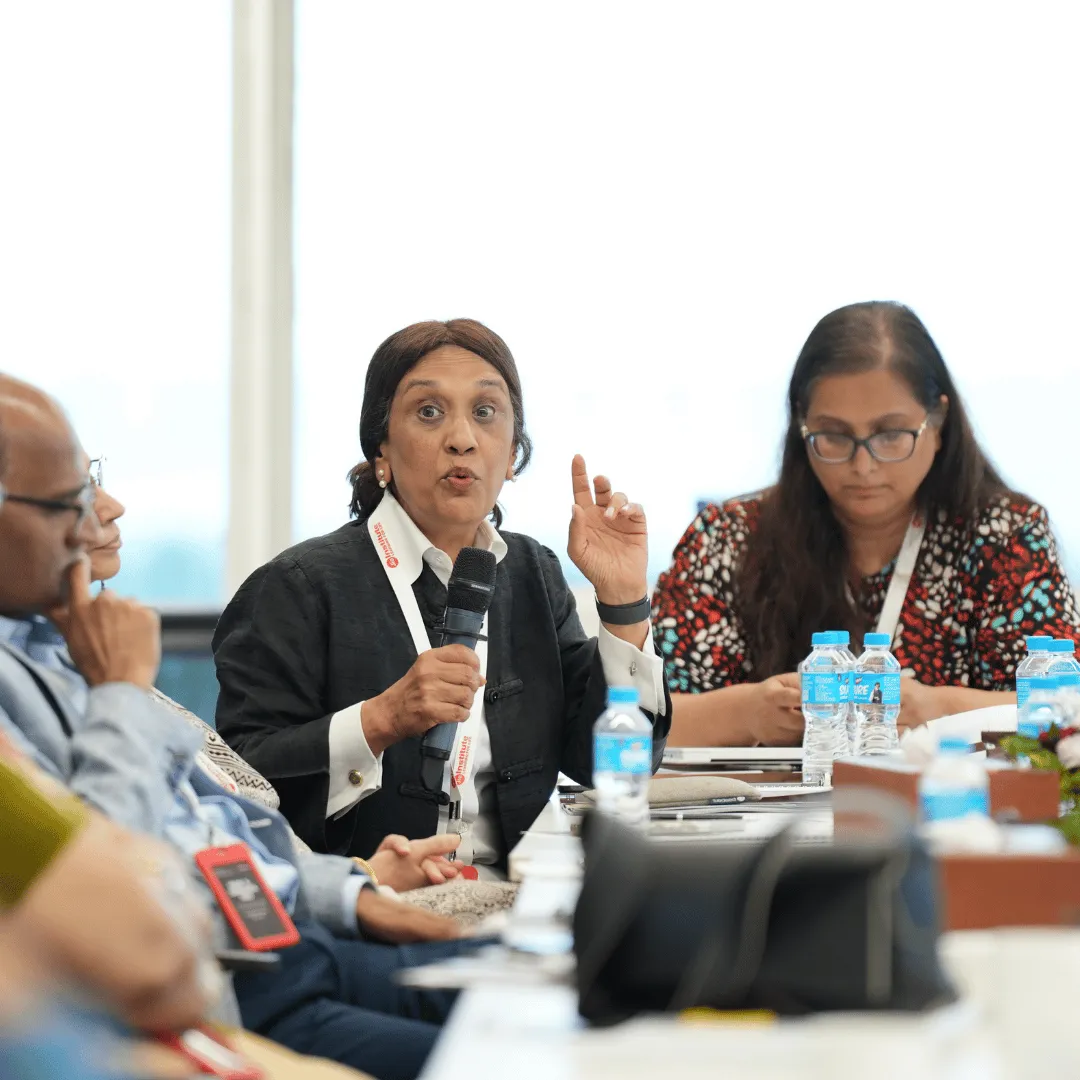
Roundtable Discussion | 11 August 2026 | Jio Institute, Navi Mumbai
For years, the question confronting teacher preparation was transactional: How do we expand capacity to meet basic recruitment targets?
At EduVision Roundtable 2026, the question had fundamentally changed.
As evolving learner demographics, digital integration, and shifting institutional mandates redefine the classroom, a more foundational academic inquiry is emerging: how must modern Schools of Education be architected to serve as centres of pedagogical innovation, multidisciplinary knowledge creation, and systemic leadership?
This inquiry shaped the high-level dialogue convened at Jio Institute, Navi Mumbai. Bringing together senior academics, institutional leadership, teacher education scholars, policymakers, and reformers, the day-long forum explored curricular architectures, foundational learning, research ecosystems, and systemic capacity building.
The roundtable convened representatives from 26 universities, foundations, and development organisations—including IGNOU, TISS, Azim Premji University, Ashoka University, JNU, Jamia Millia Islamia, and the University of Hong Kong, alongside leadership from the Reliance Foundation and EY-Parthenon.
The Evolving Landscape: Policy, AI, and Curricular Architectures
The morning opened with an examination of how academic frameworks and teacher preparation models must evolve under national mandates.
Moderated by Dr Ruchi S. Kumar (Assistant Professor, Centre of Excellence in Teacher Education, TISS), the first session addressed regulatory alignments under the National Education Policy (NEP) 2020 and evolving National Council for Teacher Education (NCTE) frameworks. Participants analyzed the expanding remit of educators, noting that contemporary preparation must look beyond instructional delivery to educational research, curriculum design, learning science, and system leadership.
Integrating technology emerged as a core intellectual challenge. Panellists emphasized that Artificial Intelligence must be integrated into pedagogical inquiry, psychometric assessment, and personalised learning pathways. The academic consensus was clear: Schools of Education must design curricula that balance theoretical rigor with field-based clinical practice, ensuring educators transition from disseminators of static content into architects of active learning environments.
Foundations of Learning: Early Childhood and Cognitive Development
The afternoon shifted focus to developmental foundations, examining global empirical evidence surrounding early childhood education.
Drawing on comparative research presented by scholars including Dr Nirmala Rao (Professor Emeritus, University of Hong Kong), discussions highlighted how early social, cognitive, and linguistic environments establish neural baselines for lifelong learning. Global longitudinal evidence demonstrates that evidence-based early educational interventions yield the highest cognitive and social dividends. For India, creating sustainable academic models in early childhood requires building rigorous early-development curricula, training specialized faculty, and generating empirical research rooted in child-development science.
Building Institutions of Excellence: Research, Doctoral Pipelines, and Knowledge Production
The dialogue then turned to the institutional mechanisms required to build world-class education faculties and scholarly output.
Moderated by Ms Greta D'Souza (Professor and Chair, School of Education, CHRIST Deemed to be University), Session 2 addressed structural challenges in academic knowledge creation. Institutional heads—including Prof Dhananjay Joshi (Dean, University School of Education, GGSIPU) and Prof V. N. Rajasekharan Pillai (Advisor & Professor of Eminence, Jio Institute)—examined strategies for recruiting faculty, cultivating doctoral research pipelines, and formalising the role of "Professors of Practice".
Participants stressed the urgent need for context-driven academic and policy research that directly addresses Indian classroom realities. Sustaining rigorous scholarship requires cross-sectoral funding partnerships, active research labs, and transparent governance systems that preserve academic autonomy while maintaining accountability to society.
From Instruction to Institutional Transformation
In framing remarks, Jio Institute leadership outlined an institutional ambition to build future-oriented academic models. Dr Palak Sheth (Project Director), alongside Mr V. P. Joy (Senior Executive Vice-President, RIL) and Ms Vanita Sharma (Advisor – Strategic Initiatives, Reliance Foundation), reaffirmed the institution's commitment to advancing educational reform and teacher development.
Summing up the dialogue, participants underscored that educational transformation cannot happen in isolation. Building high-impact Schools of Education requires an integrated knowledge network that links universities, experimental schools, regulatory authorities, and civil society.
One Room. One Common Mission.
Across diverse vantage points—from regulatory governance and cognitive psychology to early childhood pedagogies and systemic policy—EduVision 2026 approached education reform through a unified academic lens.
The core conclusion remained resolute.
Infrastructure, educational technology, and curricular mandates are essential operational engines. Yet the quality of any education system will never exceed the intellectual depth of its educators. Transforming the nation's schools begins with reimagining the institutions that educate the educators—empowering them with the scholarship, research capability, and professional stature required to lead society forward.