
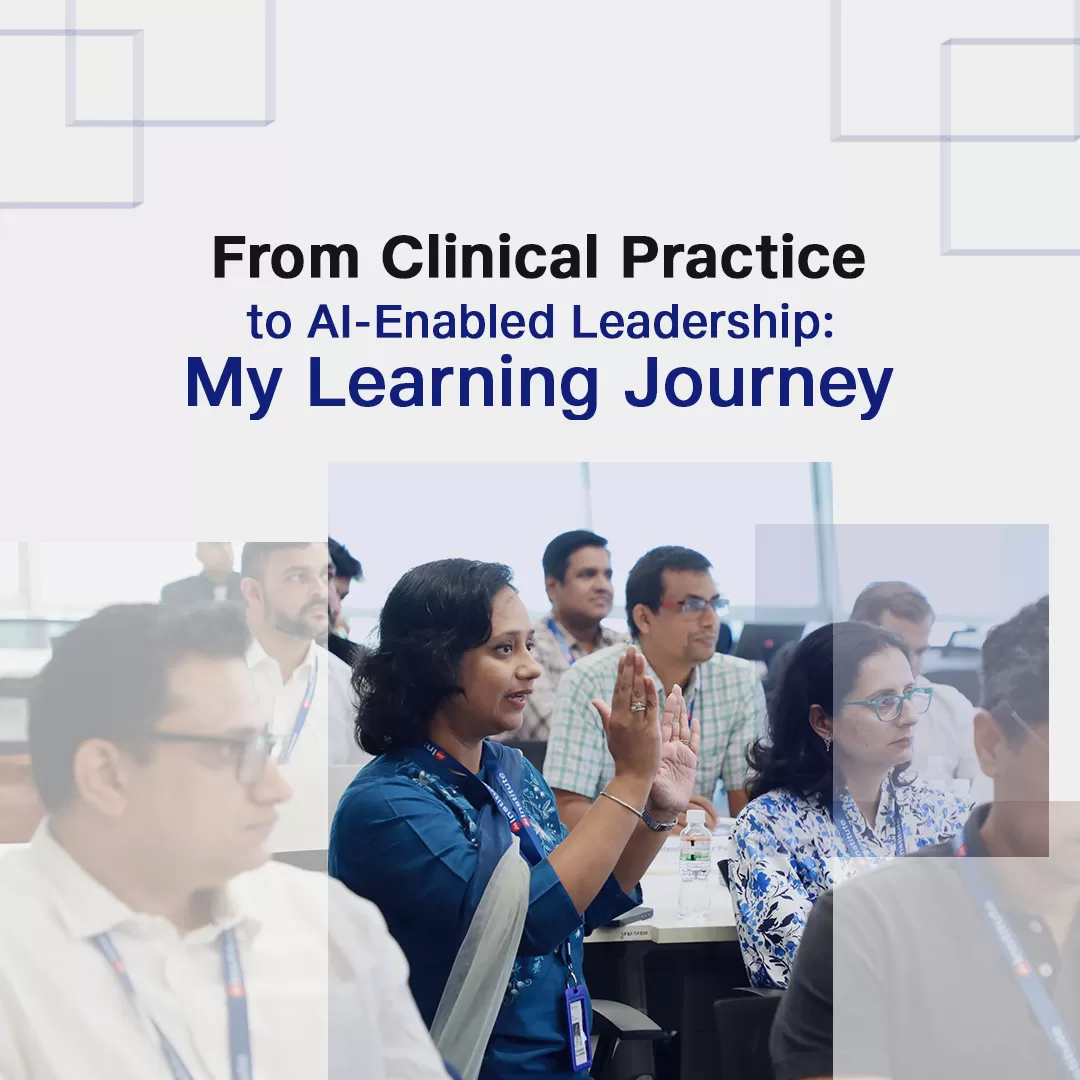
From Clinical Practice to AI-Enabled Leadership: My Learning Journey
As a practising doctor and hospital leader, I have always believed that medicine is both science and judgement. Over the past few years, artificial intelligence has begun entering conversations across departments. Vendors promised efficiency.Conferences showcased predictive models. Colleagues discussed automation in imaging and triage.
Yet, a fundamental question remained unanswered for me.
How does AI actually improve hospital operations without compromising clinical responsibility?
This question led me to enrol in the AI for Healthcare Executive Programme.
Why I Chose to Attend
Working within a large hospital ecosystem means balancing patient care with operational complexity. Bed management, staff allocation, scheduling bottlenecks, discharge delays, and documentation burden create daily pressure.
AI seemed promising, but I wanted clarity rather than excitement.
The programme’s focus on decision-making and responsible adoption resonated with me. It was not positioned as a technical course. It was designed for doctors in leadership roles.
The Shift from Curiosity to Clarity
During the first few sessions, I realised how often AI discussions stay superficial. The programme immediately redirected attention towards impact and feasibility.
Instead of asking, “What can AI do?”, we were encouraged to ask:
- Where does AI meaningfully reduce clinical risk?
- Where does it optimise hospital flow?
- Where does it introduce ethical complexity?
This shift in framing changed how I now evaluate every AI proposal presented in my organisation.
AI in Hospital Operations: A New Perspective
One of the most powerful takeaways for me was understanding AI in operational contexts.
Hospital systems struggle with:
- Bed flow inefficiencies
- Scheduling unpredictability
- Resource allocation imbalance
- Revenue leakage due to documentation gaps
Through structured case discussions, I began seeing how AI supports throughput management and backlog reduction while keeping patient safety central.
The programme did not oversell automation. Instead, it emphasised augmentation. AI assists decision-making. It does not replace clinical oversight.
This distinction now shapes my conversations with administrators and technology teams.
Clinical Decision-Making in an AI-Augmented Environment
As clinicians, we guard diagnostic responsibility carefully. Any system that influences triage or early warnings must meet high standards.
The sessions on clinical AI were especially relevant. We explored risk scoring models, early warning systems, and patient monitoring frameworks. What stood out was not the sophistication of algorithms but the governance around them.
Key considerations included:
- Data quality
- Bias detection
- Validation within the local context
- Continuous monitoring
I left with a stronger appreciation for responsible design and post-implementation oversight.
Peer Learning That Strengthened Perspective
The residential format played a significant role in the experience. Conversations extended beyond formal sessions. Cardiologists, neurologists, administrators, and healthcare entrepreneurs shared candid reflections.
Listening to peers facing similar pressures broadened my understanding. It became clear that operational challenges are universal, even if clinical contexts differ.
The environment encouraged debate without defensiveness. That atmosphere of trust made the learning deeper.
Ethics Was Not a Side Conversation
One of my concerns before attending was whether ethics would receive sufficient attention. In healthcare, trust is foundational.
The programme treated ethics as central rather than optional. Discussions around consent, explainability, and fairness were practical and grounded in hospital realities.
This reinforced an important insight. Responsible AI begins before deployment. Governance structures must be clear from the start.
What Changed After the Programme
The most meaningful shift for me was mindset.
Earlier, AI appeared as an external innovation entering healthcare. Now, I see it as a tool that requires medical leadership.
I approach AI proposals differently:
- I ask about validation data
- I evaluate operational impact
- I consider staff readiness
- I assess the patient communication strategy
This structured evaluation strengthens confidence and protects institutional integrity.
Why This Programme Matters for Senior Doctors
Senior clinicians often carry dual responsibility. We lead departments while practising medicine. AI adoption cannot remain a technology department decision.
This programme equips medical leaders to:
- Engage meaningfully with data science teams
- Evaluate risk with clarity
- Advocate for patient-centred implementation
- Align AI initiatives with institutional strategy
The experience was focused, practical, and intellectually rigorous.
Key Takeaways
- AI adoption requires clinical leadership
- Operational efficiency must not compromise patient safety
- Governance and ethics are foundational, not secondary
- Peer dialogue enhances strategic thinking
- Decision-making frameworks matter more than tools
Take the Next Step with Jio Institute
If you are a medical leader seeking structured clarity on AI adoption, the AI for Healthcare Executive Programme (Second Edition) at Jio Institute offers a focused and thoughtful learning experience.
Explore the programme and strengthen your leadership in an AI-enabled healthcare landscape.
Frequently Asked Questions
Is this programme suitable for senior MD doctors?
Yes. The discussions are designed for experienced clinicians involved in leadership or administrative roles.
Do participants need a technical background?
No. The focus remains on application, judgment, and governance rather than coding or algorithm development.
Does the programme address real hospital challenges?
Yes. Case discussions centre on bed flow, triage, patient monitoring, and operational efficiency.
How intensive is the format?
The three-day residential structure is intensive but manageable, especially for doctors with limited availability.