
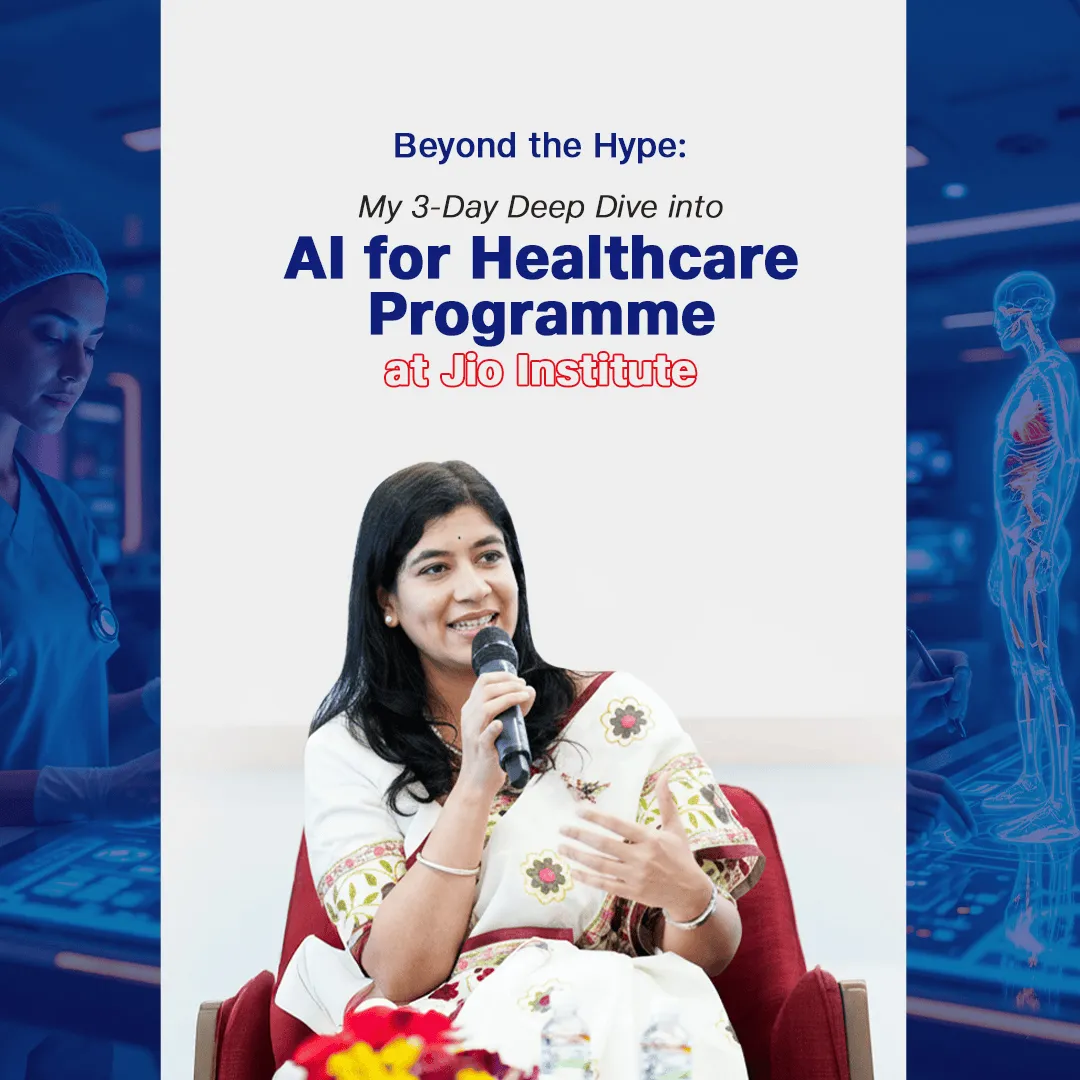
Beyond the Hype: My 3-Day Deep Dive into AI for Healthcare at Jio Institute
As a healthcare professional, I’ve spent the last year hearing about how Artificial Intelligence will "revolutionize" medicine. But between the flashy vendor pitches and complex technical jargon, I often found myself asking: What does this actually mean for my patients? And how do I lead my team through this change without losing the human touch that defines care?
This past year, I joined the first edition of the AI for Healthcare Executive Programme at Jio Institute seeking those answers. What I found was a learning experience that finally connected the potential of technology with the messy, high-stakes reality of clinical practice.
Cutting Through the Noise
From Day 1, it was clear this was not just another tech seminar. The programme focuses on cutting through the noise to identify genuine, high-impact AI opportunities rather than following the latest hype. As someone used to evidence-based outcomes, I appreciated the faculty’s emphasis on clinical judgment and operational feasibility.
We did not just talk about algorithms; we explored how AI could be a tool for Clinical Decision Support, helping us with risk scoring, early warning systems, and more efficient triaging.
Real-World Application, Not Abstract Theory
The curriculum was a three-day sprint designed for immediate application. One of the most eye-opening modules for me was on Hospital Operations. It made me realize that AI is not just for diagnostics; it is a powerful ally in tackling scheduling chaos, bed flow bottlenecks, and supply chain inefficiencies.
Ms. Priyadarshini Iyer, a fellow participant from Humm Info Care, summed it up perfectly when she noted how the sessions helped us reflect on how AI can simplify everyday challenges without replacing human intelligence.
Ethics at the Forefront
Perhaps the most critical takeaway for me was the deep dive into Ethics, Privacy, and Implementation. In healthcare, patient safety and trust are non-negotiable. Learning practical frameworks for data de-identification, fairness testing, and consent was vital. As Dr. Devashree Kunal Karande from Sir HN Reliance Foundation Hospital observed, the programme taught us that AI must be integrated from the very beginning of a process rather than after it is in motion to truly serve patient advocacy.
The Power of the Peer Network
Beyond the curriculum, the atmosphere at the 52-acre residential campus in Ulwe was incredible. I found myself in the company of CEOs, senior medical administrators, and innovation leaders from organizations like Echelon and Karkinos Healthcare.
The peer learning was just as valuable as the faculty instruction. Whether it was discussing a capstone project proposal or sharing challenges over dinner, the collaboration was inspiring. Dr. Naveen KN, CEO of Echelon Hospital, shared a sentiment many of us felt: the experience was truly amazing and provided deep insights into how AI is transforming our field.
Final Thoughts
I walked away from the Jio Institute not just with a certificate, but with a practical framework for driving AI-enabled change. I no longer see AI as a distant future concept; I see it as a strategic tool I can use today to improve patient outcomes and streamline our operations.
For my colleagues who are ready to move beyond the conversation and into action, the Second Batch is coming up from February 26th to 28th, 2026. If you want to lead the AI conversation in your organization with confidence and responsibility, I cannot recommend this experience enough.